

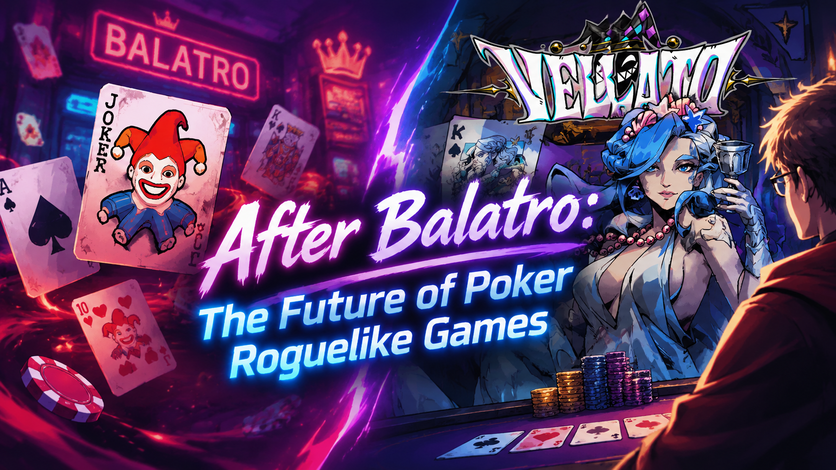
Balatro Effect Changed How Players See Card Games
The indie game industry has always been driven by unexpected ideas.
Every few years, a small independent title appears and proves that a simple concept can become something much bigger.
In 2024, that game was Balatro.
At first glance, Balatro looked like a simple poker-inspired card game. The concept seemed familiar:
- Poker hands
- Playing cards
- Score calculation
- Casino-inspired visuals
However, after millions of players experienced the game, it became clear that Balatro was not simply a poker game.
It was a revolutionary interpretation of how card-based strategy games could work.
By combining:
- Poker mechanics
- Roguelike progression
- Deckbuilding strategy
- Endless replayability
Balatro created one of the most successful examples of a modern roguelike card game.
More importantly, it proved something significant:
A traditional game mechanic can become a completely new experience when combined with the right design philosophy.
Poker was no longer just about making the strongest hand.
In Balatro, players were:
- Building strategic engines
- Creating powerful combinations
- Discovering unexpected synergies
- Breaking the rules through creative builds
This approach inspired a new generation of developers.
After Balatro’s success, Steam began seeing more experiments based around:
- Poker roguelikes
- Blackjack deckbuilders
- Casino-inspired strategy games
- Card-based indie games
However, not every game inspired by Balatro can achieve the same impact.
The reason is simple:
Copying mechanics is easy.
Creating a new identity is difficult.
The Difference Between Inspiration and Imitation
The success of Balatro created a new opportunity in the indie market.
Developers quickly understood the appeal:
Players enjoy:
- Simple rules
- Deep strategy
- Randomized runs
- Endless experimentation
This formula is extremely attractive.
A basic version looks like:
Card System
+
Upgrades
+
Random Events
+
Strategic Builds
=
Roguelike Card Game
But this formula alone is not enough.
The biggest challenge for any Balatro-inspired game is answering one question:
“Why should players choose this game instead of Balatro?”
The strongest games after Balatro are not the ones that copy the Joker system or recreate poker scoring.
They are the games that find a new perspective.
Examples:
- Black Jacket asks: “What happens if blackjack becomes a roguelite deckbuilder?”
- Poker Quest asks: “Can poker become an RPG adventure system?”
- Velato asks: “What if poker roguelikes focus on bluffing and defeating another mind?”
This difference is what separates a clone from an evolution.
How Balatro Changed the Roguelike Card Game Market
Balatro Turned Poker Into a Strategic Engine
Traditional poker is built around one central idea:
Create the strongest possible hand.
Balatro changed that.
The goal was no longer simply:
“Can you make a straight or flush?”
Instead, the game asked:
“Can you create a system where your cards, modifiers, and decisions multiply each other’s power?”
The Joker system became the foundation of this idea.
A single Joker could completely change how players approached a run.
A weak strategy could suddenly become powerful because of the right combination.
This created the feeling that every run was an experiment.
Players were constantly asking:
- What if I build around this mechanic?
- Can this combination break the game?
- How far can this strategy go?
That curiosity became one of Balatro’s strongest strengths.
Why Players Love Balatro-Like Games
1. Familiar Rules With Unexpected Depth
One of the biggest advantages of poker-based games is accessibility.
Most players understand basic poker concepts.
They already know ideas like:
- Pair
- Straight
- Flush
- High card
However, a roguelike system adds another layer.
Suddenly, players are not only thinking about the cards they have.
They are thinking about:
- Future upgrades
- Long-term strategy
- Resource management
- Synergy
This creates a perfect balance:
Easy to understand.
Difficult to master.
2. Every Run Creates a Different Experience
A great roguelike card game does not rely only on winning.
It relies on discovery.
Players remember moments like:
- Finding an unexpected combination
- Creating an overpowered build
- Surviving a difficult challenge
- Discovering a new strategy
This is why games like Balatro have extremely high replay value.
The player is always thinking:
“Maybe the next run will create something even better.”
3. Balatro Proved Indie Card Games Can Become Global Hits
Before Balatro, card-based indie games were often considered a niche category.
Balatro changed that perception.
It showed that an indie game does not need:
- Massive production budgets
- AAA graphics
- Huge development teams
Instead, success can come from:
- A strong core mechanic
- Excellent game design
- A unique player experience
This created confidence for developers exploring new roguelike card games.
The Biggest Opportunity After Balatro: The Human Element
Although Balatro created a new standard for single-player card strategy, it also revealed an interesting opportunity.
The original poker experience contains something that many roguelike games do not:
Human Psychology
Poker is unique because players are not only fighting against probability.
They are fighting against another person’s decisions.
The most exciting poker moments often come from:
- Bluffing
- Reading opponents
- Creating uncertainty
- Taking calculated risks
A player can win with a weaker hand.
A player can lose with the strongest hand.
Why?
Because poker is not only mathematics.
It is psychology.
This creates a major opportunity for the next generation of poker roguelike games.
The future may not only be about:
“How powerful can you make your deck?”
It may also be:
“Can you outthink the person across the table?”
This is the space where Velato begins to stand apart.
5 Games Exploring the Post-Balatro Wave of Roguelike Card Games
The success of Balatro did not create a wave of simple copies.
Instead, it encouraged developers to ask a more interesting question:
“What other classic game systems can be transformed into a modern roguelike card experience?”
The result is a new generation of Balatro-inspired games that approach the formula from different angles.
Some developers are experimenting with casino classics like blackjack.
Others are combining poker with RPG systems.
Some are exploring entirely new forms of card-based strategy.
Among these experiments, a few titles stand out because they do not simply imitate Balatro — they attempt to expand the possibilities of the genre.
1. Black Jacket – When Blackjack Becomes a Roguelite Deckbuilder
Black Jacket is one of the clearest examples of how developers are expanding the ideas introduced by Balatro.
Instead of using poker as the foundation, Black Jacket asks a different question:
“Can blackjack become a deep strategic roguelike experience?”
The answer is an interesting experiment.
Black Jacket takes the familiar blackjack formula:
- Hit
- Stand
- Manage risk
- Aim for the optimal number
and transforms it with roguelite systems:
- Deck customization
- Card upgrades
- Special effects
- Strategic choices
- Rule manipulation
The result is a game that feels familiar but creates a completely different strategic challenge.
Why Black Jacket Works as a Balatro-Inspired Game
The biggest strength of Black Jacket is that it understands the core lesson behind Balatro:
A simple casino mechanic can become a complex strategy system.
Traditional blackjack is often viewed as a game of probability.
However, a roguelite structure changes the experience.
Players are no longer only asking:
“Should I hit or stand?”
They are also thinking:
- Which cards should I upgrade?
- Which strategy should I build around?
- When should I take a risk?
- How can I manipulate the odds?
This transformation is exactly what made Balatro successful.
Balatro did not simply recreate poker.
It turned poker into a strategic sandbox.
Black Jacket attempts to do the same thing with blackjack.
Black Jacket vs Balatro: Different Approaches to Casino Strategy
| Feature | Balatro | Black Jacket |
|---|---|---|
| Original inspiration | Poker | Blackjack |
| Main mechanic | Poker hands + modifiers | Blackjack decisions + card manipulation |
| Core strategy | Build powerful combinations | Manage probability and risk |
| Player fantasy | Create a broken strategy engine | Control the odds |
| Main challenge | Optimization | Decision-making under uncertainty |
Where Black Jacket Differs From Balatro
Although both games belong to the same family of roguelike card games, their strategic identities are different.
Balatro is about:
“How powerful can your build become?”
Black Jacket is more about:
“How effectively can you manage risk?”
This difference is important.
A successful roguelike does not need the same mechanics as another successful game.
It needs a unique reason for players to keep playing.
The Limitation: Still Mostly a Battle Against the System
The biggest difference between Black Jacket and traditional poker is the human element.
Blackjack is primarily about:
- Probability
- Decision-making
- Risk calculation
Poker adds another layer:
- Deception
- Bluffing
- Reading opponents
This psychological battle is one of the reasons poker remains one of the most strategically interesting card games in the world.
Black Jacket successfully expands blackjack into a roguelite format.
However, the challenge of competing against another human mind remains an unexplored opportunity.
This is where games like Velato take a different approach.
2. Poker Quest – Turning Poker Into an RPG Adventure
Another interesting experiment in the post-Balatro era is Poker Quest.
While Balatro focuses on poker as a scoring system, Poker Quest explores another possibility:
“What if poker became the foundation of an RPG adventure?”
Instead of only building card combinations, players use poker mechanics as part of a larger progression system.
The game combines:
- Poker hands
- Character abilities
- Exploration
- Combat decisions
- RPG progression
Why Poker Quest Matters
Poker Quest demonstrates that poker is not limited to casino gameplay.
The basic principles of poker can support different genres.
Poker can become:
- A combat system
- A resource mechanic
- A progression tool
- A strategic decision framework
This is similar to what Balatro achieved.
Both games prove that familiar systems can become something completely new when redesigned correctly.
Poker Quest vs Balatro
The difference comes from the player’s objective.
In Balatro:
The player builds a machine.
Every card, Joker, and modifier contributes toward creating a stronger scoring engine.
In Poker Quest:
The player builds a character and uses poker mechanics to overcome challenges.
The experience is closer to an RPG adventure than a pure deckbuilder.
The Challenge
However, like many single-player card games, Poker Quest still focuses mainly on defeating game-generated challenges.
The opponent is:
- The AI system
- The encounter design
- The difficulty curve
The psychological element of poker remains limited.
Players are solving a puzzle created by the game rather than trying to outsmart another person.
3. Luck Be A Landlord – The Same Philosophy Without Poker
At first glance, Luck Be A Landlord does not appear connected to Balatro.
It does not use poker.
It does not use traditional playing cards.
However, it represents the same design philosophy that made Balatro successful.
The game focuses on:
- Randomized runs
- Symbol combinations
- Scaling strategies
- Build optimization
The player creates a system that becomes increasingly powerful over time.
The Connection Between Luck Be A Landlord and Balatro
The lesson is not about cards.
The lesson is about systems.
Both games understand that players enjoy:
- Discovering combinations
- Experimenting with builds
- Finding unexpected strategies
- Breaking traditional rules
This is one of the strongest characteristics of modern roguelike design.
The theme can change.
The underlying satisfaction remains the same.
4. The Growing Wave of Indie Card Game Experiments
After Balatro’s success, many indie developers started exploring similar design spaces.
The new generation of roguelike card games includes experiments with:
- Poker
- Blackjack
- Dice systems
- Casino mechanics
- Strategy cards
- Hybrid RPG systems
This trend makes sense.
Card games provide developers with several advantages:
Simple Foundation
Players immediately understand the basic idea.
Deep Strategic Possibilities
Small rule changes can completely change gameplay.
High Replay Value
Randomized systems naturally create new experiences.
However, this market also creates a major challenge.
Many games can recreate the structure:
Cards
+
Upgrades
+
Random Runs
+
Powerful Builds
But players eventually ask:
“What makes this game special?”
Balatro had the Joker system.
Other successful games need their own defining mechanic.
Without a unique identity, many titles risk becoming forgotten among hundreds of similar indie releases.
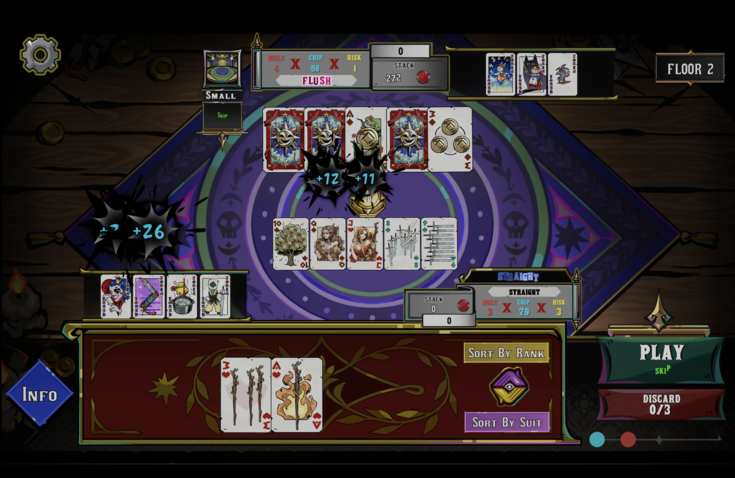
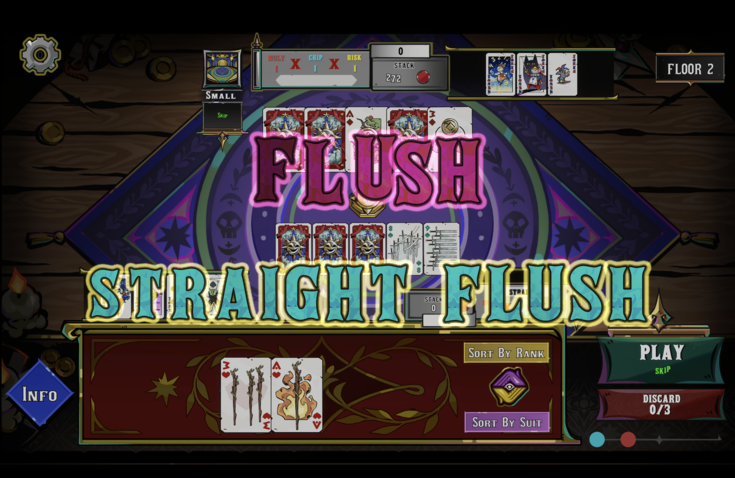
5. Velato – A Different Evolution of the Poker Roguelike Formula
Among the growing number of Balatro-inspired games, Velato stands out because it focuses on a different part of poker.
Many games inspired by Balatro ask:
“How can we create a stronger card-building system?”
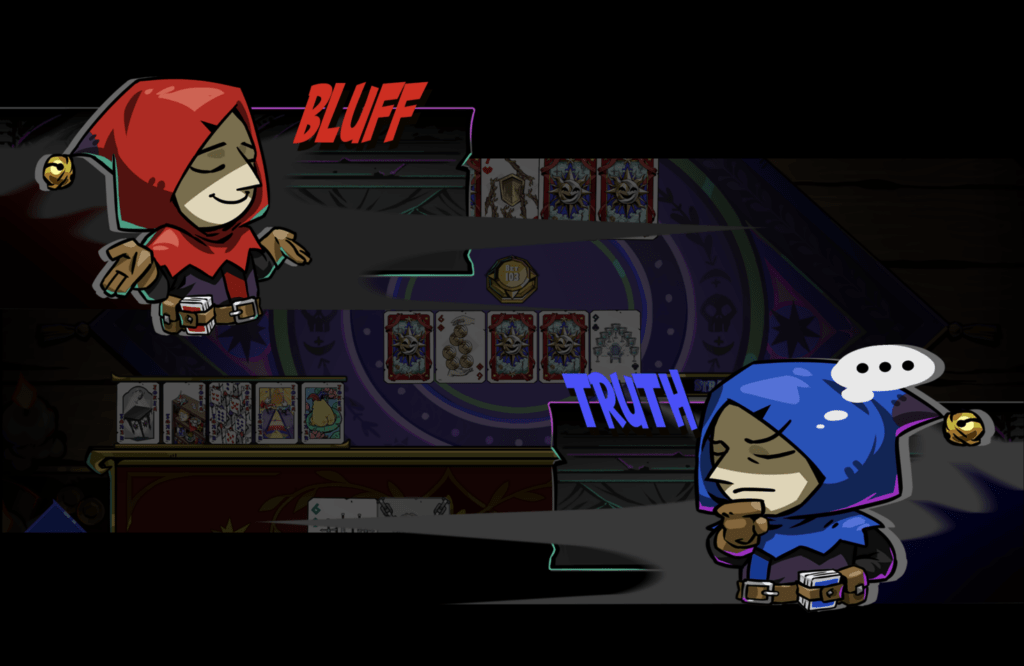
Velato asks:
“How can we bring the actual mind game of poker into a roguelike experience?”
That difference is important.
Velato Steam Page: https://store.steampowered.com/app/4542750/VELATO/

Velato Is Not Just Another Balatro-Inspired Game
At a surface level, Velato shares similarities with Balatro:
Both are built around:
- Poker mechanics
- Card strategy
- Roguelike progression
- Replayability
However, the core fantasy is different.
Balatro is about:
Creating the perfect strategy engine.
Velato is about:
Using strategy and psychology to defeat opponents.

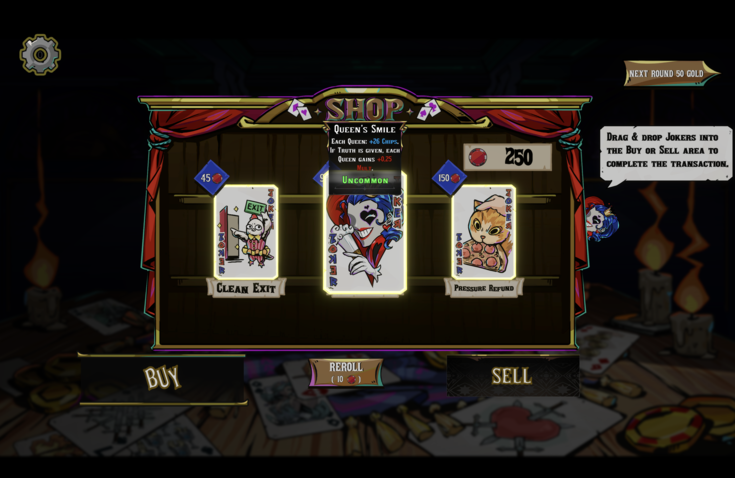
The Missing Ingredient: Actual Poker Bluffing
Traditional poker has two layers.
Layer 1: Mathematical Strategy
Players analyze:
- Hand strength
- Probability
- Risk
This part exists in many card games.
Layer 2: Psychological Strategy
Players analyze:
- Opponent behavior
- Betting patterns
- Confidence
- Intentions
This is the part that makes poker unique.
A player can win without having the strongest hand.
A player can lose despite having an advantage.
Because poker is not only about cards.
It is about information.
Why Bluffing Creates a New Type of Replayability
Most roguelike card games are based around solving systems.
The player learns:
- Which cards are strongest
- Which combinations work best
- Which strategies scale efficiently
But human opponents create something different:
Uncertainty.
A strategy that works once may fail because another player adapts.
This creates a constantly changing experience.
Instead of asking:
“What is the strongest build?”
Players start asking:
- “Does my opponent believe me?”
- “Are they hiding strength?”
- “Should I take the risk?”
These are the questions that define poker.
Velato and the Future of Poker Roguelike Games
One of the biggest opportunities after Balatro is expanding poker roguelikes beyond single-player optimization.
Balatro proved that poker can create a successful roguelike.
Velato explores another possibility:
What happens when poker strategy includes the human element?
By combining:
- Roguelike progression
- Poker mechanics
- Bluffing strategy
- Competitive interaction
Velato represents one of the more interesting directions for the next generation of poker roguelike games.
Why Velato Has Potential in the Post-Balatro Market
The timing is important.
The audience already understands the appeal of poker-based roguelikes.
Players who enjoy Balatro already appreciate:
- Card strategy
- Risk management
- Creative builds
But some players may also want:
- More competition
- More interaction
- More psychological depth
Velato has the opportunity to connect multiple audiences:
Roguelike Players
Looking for:
- Replayability
- Strategy
- Unique builds
Card Game Players
Looking for:
- Tactical decisions
- Probability management
Poker Players
Looking for:
- Bluffing
- Mind games
- Competitive decisions
This combination gives Velato a unique position among emerging Balatro-inspired games.
Balatro vs Black Jacket vs Velato: Three Different Futures of Poker Roguelike Games
The success of Balatro created more than just a popular indie title.
It created a new design space.
Before Balatro, combining poker and roguelike mechanics seemed like a niche experiment.
After Balatro, developers and players discovered that casino-inspired mechanics could become the foundation for deep strategic games.
However, the future of the genre will not be defined by games that simply recreate Balatro.
The next breakthrough titles will likely come from developers who understand why Balatro works and then introduce a new layer of innovation.
Looking at Balatro, Black Jacket, and Velato reveals three different approaches to the future of poker roguelike games.
Balatro vs Black Jacket vs Velato: Three Approaches to Casino-Inspired Roguelikes
| Feature | Balatro | Black Jacket | Velato |
|---|---|---|---|
| Inspiration | Poker | Blackjack | Poker |
| Core Genre | Roguelike deckbuilder | Roguelite card strategy | Poker roguelike |
| Main Focus | Building powerful combinations | Managing risk and probability | Strategy + bluffing |
| Main Challenge | Optimize your build | Control uncertainty | Outsmart opponents |
| Player Fantasy | Create a broken card engine | Master blackjack decisions | Become the better poker player |
| Opponent Type | Game system | AI encounters | Human interaction potential |
| Replayability | Random builds | Random strategies | Decisions and mind games |
| Biggest Innovation | Joker system | Blackjack transformation | Psychological poker gameplay |
Different Games, Different Answers to the Same Question
The interesting thing about these three games is that they are not trying to solve the same problem.
They each answer a different question.
Balatro:
“How can poker become an addictive roguelike strategy system?”
Black Jacket:
“How can blackjack become a deeper deckbuilding experience?”
Velato:
“How can we bring the real mind game of poker into a roguelike format?”
This is why comparing them is useful.
They represent different stages of genre evolution.
Why Balatro Remains the Foundation of This New Genre
Balatro’s biggest achievement was not simply popularity.
It changed player expectations.
It showed that a card game could be:
- Simple to understand
- Deep to master
- Highly replayable
- Extremely creative
The game’s biggest innovation was the transformation of poker hands into a strategic engine.
A player was not simply trying to win a poker round.
They were building an entire system around:
- Jokers
- Multipliers
- Synergies
- Scaling strategies
This created a unique type of satisfaction:
The feeling of discovering a strategy that feels almost impossible.
That design philosophy influenced many Balatro-inspired games.

Why Black Jacket Represents the Expansion of the Formula
Black Jacket takes a different path.
Instead of asking:
“How can poker evolve?”
It asks:
“Can blackjack become equally strategic?”
This is important because it expands the possibilities of casino-inspired roguelikes.
The lesson from Balatro was not:
“Every future game needs poker.”
The real lesson was:
“Any familiar system can become a great roguelike if redesigned properly.”
Black Jacket proves that blackjack — a game often considered simpler than poker — can also support:
- Strategy
- Risk management
- Build decisions
- Long-term planning
It represents the system innovation direction of the genre.
Why Velato Represents the Next Possible Step
While Balatro and Black Jacket focus heavily on systems, Velato explores something different:
The human side of poker.
This distinction matters because poker has always been unique among card games.
A traditional card game asks:
“Do you have the better hand?”
Poker asks:
“Can you convince someone that you have the better hand?”
That psychological layer creates endless possibilities.
Velato’s Key Difference: From Building Cards to Reading Players
Many roguelike card games are based on optimization.
Players learn:
- The strongest combinations
- The best upgrades
- The most efficient strategies
This creates a puzzle-solving experience.
Velato introduces another layer:
Decision-making under uncertainty.
Players must consider:
- What does the opponent have?
- Are they bluffing?
- Should I take the risk?
- Can I force a mistake?
This changes the entire gameplay experience.
The challenge is no longer only:
“Can I build a stronger strategy?”
It becomes:
“Can I outplay another strategy?”
Why PvP Could Be the Next Evolution of Poker Roguelikes
One of the biggest opportunities in the post-Balatro market is competitive gameplay.
Currently, many roguelike card games focus on:
- Single-player progression
- AI opponents
- Endless runs
These experiences are excellent.
However, poker has always been built around competition.
The excitement comes from:
- Uncertainty
- Mind games
- Player decisions
A competitive poker roguelike could combine:
The Creativity of Roguelikes
Players can create unique builds and strategies.
The Depth of Card Games
Players manage:
- Probability
- Resources
- Risk
The Psychology of Poker
Players interact with another mind.
This combination creates an unexplored opportunity.
Why Velato Has the Potential to Stand Out Among Balatro-Inspired Games
The post-Balatro market will become increasingly competitive.
More developers will create:
- Card roguelikes
- Deckbuilders
- Casino-inspired games
Standing out will require more than having cards and upgrades.
A successful game needs a strong identity.
Velato’s identity comes from combining:
1. Poker Familiarity
Players immediately understand the foundation.
Poker is globally recognized.
2. Roguelike Depth
Players get:
- Replayability
- Strategic choices
- Different approaches every run
3. Psychological Gameplay
The addition of bluffing creates something many card games lack:
Human unpredictability.
4. Competitive Potential
While many roguelike card games are focused on PvE experiences, Velato explores a direction closer to what poker players naturally enjoy:
Competing against another decision-maker.
The Future of Balatro-Inspired Games in 2026 and Beyond
The success of Balatro is likely the beginning of a larger trend.
The next generation of roguelike card games will probably explore several directions.
Trend 1: More Genre Hybridization
Developers will continue combining:
- Card games
- RPG systems
- Strategy games
- Casino mechanics
- Multiplayer features
The future will belong to games that create unexpected combinations.
Trend 2: Competitive Roguelike Experiences
Traditional roguelikes are usually single-player.
However, competitive games continue to demonstrate the value of human interaction.
Future games may combine:
- Roguelike progression
- Deckbuilding creativity
- PvP competition
This could become one of the biggest opportunities in the genre.
Trend 3: Psychology-Based Mechanics
Numbers and optimization are powerful.
But uncertainty creates emotion.
Mechanics like:
- Bluffing
- Hidden information
- Prediction
- Mind games
could become important differentiators for future poker roguelikes.
FAQ
What are the best games like Balatro in 2026?
Some interesting games like Balatro include Black Jacket, Poker Quest, Luck Be A Landlord, and Velato. Each game explores a different interpretation of roguelike strategy, from blackjack mechanics to poker-based gameplay.
Is Black Jacket similar to Balatro?
Black Jacket shares similarities with Balatro because both transform traditional casino mechanics into roguelite strategy experiences. However, Black Jacket focuses on blackjack, probability management, and risk decisions rather than poker combinations.
Is Velato a Balatro clone?
No. While Velato shares the poker roguelike foundation, it focuses on a different aspect of poker: bluffing, opponent interaction, and strategic decision-making.
Velato aims to expand the formula rather than simply recreate Balatro.
What makes Velato different from other poker roguelike games?
Velato focuses on the psychological side of poker.
Instead of only optimizing cards and combinations, players must consider strategy, uncertainty, and opponent behavior.
Does Balatro have PvP multiplayer?
Balatro is primarily a single-player roguelike experience. The game focuses on building powerful strategies against the game’s systems rather than direct competition between players.
Conclusion: Balatro Started the Revolution, But the Next Chapter Is Still Being Written
Balatro changed the perception of what a card game could become.
It proved that poker could support:
- Deep strategy
- Endless replayability
- Modern roguelike design
The games following Balatro are not simply copies.
Black Jacket shows that blackjack can become a strategic roguelite.
Poker Quest demonstrates that poker can expand into new genres.
Other indie experiments prove that players are hungry for creative card-based systems.
But Velato represents another possibility.
Instead of only asking:
“How powerful can your strategy become?”
It asks:
“Can your strategy defeat another mind?”
That difference could define the next evolution of the poker roguelike genre.
Balatro created the foundation.
The future belongs to the games that build something new on top of it.
Related Posts
- How to Create a Steam Demo
- Steam Page SEO Checklist: 50 Proven Ways to Optimize Your Store Page
- How to Set Up a Store Page on Steam
- Steam Tags Explained: How to Choose the Best Tags for Your Indie Game
- Steam Capsule Art Guide: Design Tips That Increase Click-Through Rate
- Steam Trailer Best Practices: Create Trailers That Turn Views Into Wishlists
- What Is an Indie Game?
- Velato: A Poker Roguelike Worth Watching
References
Balatro Official Steam Page
Reference:
- Game positioning
- Genre classification
- Player reception
https://store.steampowered.com/app/2379780/Balatro
Black Jacket Official Steam Page
Reference:
- Blackjack roguelite mechanics
- Game overview
https://store.steampowered.com/app/3100370/Black_Jacket
Velato Official Steam Page
Reference:
- Game information
- Gameplay concept
- Steam reviews
https://store.steampowered.com/app/4542750/VELATO
Steamworks Documentation
Reference:
- Indie game publishing
- Steam discoverability
https://partner.steamgames.com/doc/store
GameDiscoverCo
Reference:
- Indie game market analysis
- Steam discovery trends