
Table of Contents
- What Is an Indie Game?
- What Does “Indie” Mean?
- A Brief History of Indie Games
- Indie Games vs AAA Games
- Why Indie Games Have Become So Popular
- What Is an Indie Developer?
- How Indie Games Are Made
- How Indie Developers Make Money
- Famous Indie Games That Changed the Industry
- Velato: A Modern Example of Indie Innovation
- Common Myths About Indie Games
- Frequently Asked Questions
- Final Thoughts
What Is an Indie Game?
An indie game is a video game created independently, usually by a solo developer or a small studio, without being financially or creatively controlled by a major publisher.
Although the word indie is everywhere today—especially on Steam, Nintendo Switch, PlayStation Store, and Xbox Marketplace—it remains one of the most misunderstood terms in gaming.
Many people assume indie games are simply:
- Pixel-art games
- Games made by one person
- Cheap games
- Small games
None of those definitions are entirely correct.
The true meaning of indie comes from independent.
Just like independent films or independent music, indie games are defined by creative independence, not by graphics, budget, or even team size.
That means an indie developer has the freedom to decide:
- What game to make
- How it should look
- How it plays
- When it launches
- Which platform it releases on
without a large publisher making those decisions.
This creative freedom is exactly why many of today’s most original games come from indie studios rather than billion-dollar companies.
Why Should You Care About Indie Games?
If you enjoy discovering unique gaming experiences, indie games are where many of the industry’s biggest ideas begin.
Over the last decade, indie developers have introduced mechanics that later became mainstream, including:
- Deckbuilding roguelikes
- Cozy farming simulations
- Survival crafting
- Narrative exploration
- Psychological horror
- Social deduction mechanics
Many of today’s best-selling games started as passion projects built by tiny teams.
What Does “Indie” Actually Mean?
The word Indie is simply short for Independent.
In gaming, independence refers primarily to creative and financial control.
Instead of working under publishers like:
- Nintendo
- Sony
- Microsoft
- Ubisoft
- Electronic Arts
- Activision Blizzard
indie developers usually choose one of several paths:
- Self-funding
- Crowdfunding
- Early Access
- Small independent publishers
- Government grants
- Private investment
The important distinction is that the creators retain significant influence over the direction of the game.
An indie game can therefore have:
- stunning graphics,
- millions of players,
- a large development budget,
and still be considered indie if its creative independence remains intact.
A Brief History of Indie Games
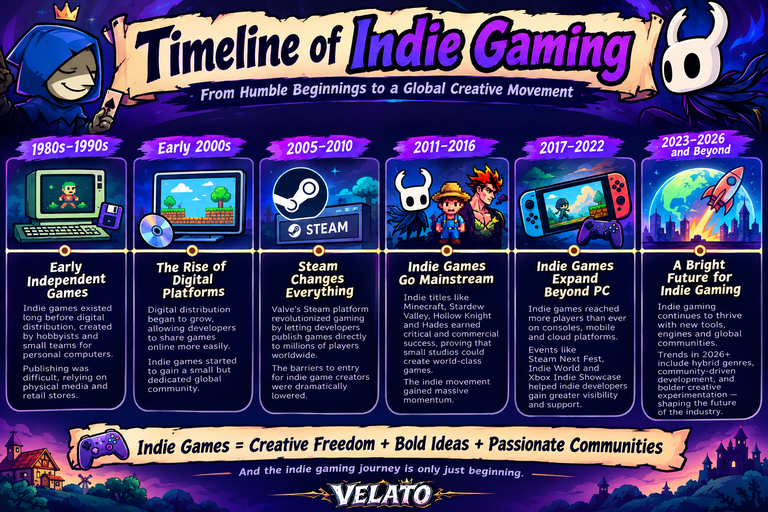
The indie movement didn’t begin with Steam.
Independent developers have existed since the early days of personal computers.
However, several milestones dramatically accelerated indie gaming’s growth.
Before Digital Distribution
In the 1980s and 1990s, publishing a game was incredibly difficult.
Developers needed:
- physical disks
- retail distribution
- manufacturing
- publisher relationships
Without a publisher, most games never reached players.
Steam Changed Everything
Everything changed when digital distribution became mainstream.
Platforms like Steam allowed developers to publish directly to millions of players without negotiating shelf space at retail stores.
Today, Steam hosts tens of thousands of indie titles across virtually every genre.
This dramatically lowered the barrier to entry for aspiring game creators.
The Rise of Modern Indie Hits
Several landmark games proved that independent studios could compete with AAA publishers.
These successes inspired thousands of new developers to pursue indie game development.
Some of the biggest examples include:
- Minecraft
- Terraria
- Stardew Valley
- Hollow Knight
- Hades
- Balatro
Each demonstrated that originality often matters more than budget.
Indie Games vs AAA Games
One of the most common questions beginners ask is:
What’s the difference between an indie game and a AAA game?
Here’s a simple comparison.
| Feature | Indie Games | AAA Games |
|---|---|---|
| Team Size | 1–50 developers | Hundreds or thousands |
| Budget | Thousands to several million dollars | Tens or hundreds of millions |
| Publisher | Independent | Large publisher |
| Creative Freedom | High | Often limited by business goals |
| Marketing Budget | Small | Massive global campaigns |
| Development Time | 1–5 years | 4–8 years |
| Innovation | Often experimental | Usually lower risk |
AAA studios must justify enormous investments, so they often rely on established franchises and familiar mechanics.
Indie studios, by contrast, can afford to take creative risks.
That is why many groundbreaking gameplay ideas emerge from indie developers first.
Are Indie Games Better Than AAA Games?
Not necessarily.
The two serve different purposes.
AAA games often deliver:
- cinematic storytelling
- cutting-edge graphics
- enormous open worlds
- blockbuster production values
Indie games often excel at:
- innovative gameplay
- unique art direction
- experimental mechanics
- niche genres
- personal storytelling
Rather than replacing AAA games, indie games expand the diversity of experiences available to players.
Many gamers enjoy both.
Why Indie Games Have Become So Popular
The popularity of indie games has grown rapidly because they offer experiences that larger studios often cannot.
Several factors contribute to this success:
Creative Freedom
Without publisher mandates, developers can build exactly the game they envision.
Lower Prices
Many indie games cost a fraction of a AAA release while offering dozens—or even hundreds—of hours of gameplay.
Strong Community Support
Indie developers often engage directly with players through Discord, Steam forums, Reddit, and Early Access, shaping their games based on community feedback.
Innovation
Some of the most influential genres in recent years—such as roguelike deckbuilders and cozy farming sims—were propelled into the mainstream by indie creators willing to experiment.
What Is an Indie Developer?
If an indie game is the product, then an indie developer—often shortened to indie dev—is the person or team behind it.
An indie developer creates games independently, without being owned or creatively directed by a major publisher. Depending on the project, an indie dev may handle everything from programming and art to marketing and community management.
Unlike developers working at large studios, indie developers often wear many hats.
For example, a solo developer may be responsible for:
- Designing gameplay mechanics
- Writing code
- Creating artwork and animations
- Composing or sourcing music
- Designing UI and UX
- Testing and fixing bugs
- Marketing the game
- Managing the Steam page
- Talking with the community
- Publishing updates after launch
In larger indie studios, these responsibilities are shared among a small team, but everyone typically contributes across multiple disciplines.
Being an indie developer isn’t just about making games—it’s about building an entire business around a creative vision.
Solo Developer vs. Indie Studio
Many people assume every indie game is created by one person.
While some famous titles were largely developed by solo creators, many successful indie games come from teams of 5–30 people.
Here’s a quick comparison:
| Solo Developer | Indie Studio |
|---|---|
| One creator handles most tasks | Small team with specialized roles |
| Lower development costs | Larger production capacity |
| Longer development time | Faster iteration |
| Greater creative control | More collaboration and expertise |
| Higher personal workload | Shared responsibilities |
Neither approach is inherently better. The right choice depends on the project’s scope, budget, and the team’s experience.
The Indie Game Development Process
Many first-time developers imagine game development starts with writing code.
In reality, coding is only one step in a much larger journey.
Most indie games follow a development pipeline similar to this:
Idea
↓

Research
↓

Game Design Document (GDD)

↓

Prototype

↓

Playtesting

↓

Core Development

↓

Art & Audio

↓

Quality Assurance

↓

Steam Store Page

↓

Marketing

↓

Launch

↓

Updates & Community Support
Let’s explore each stage.
1. Finding the Right Idea
Every successful indie game starts with a strong concept.
However, a good idea isn’t necessarily the biggest idea.
Many successful indie games focus on doing one thing exceptionally well rather than trying to include every possible feature.
Developers often ask questions such as:
- What makes this game different?
- Why would someone play this instead of an existing game?
- Is the concept fun within the first five minutes?
- Can the idea be explained in one sentence?
For example:
- Balatro combines poker with roguelike deckbuilding.
- Papers, Please transforms border inspection into a moral decision-making game.
- Untitled Goose Game turns playful mischief into a full gameplay experience.
A clear gameplay hook is often more valuable than hundreds of features.
2. Creating a Game Design Document (GDD)
Before building the game, developers usually document their ideas in a Game Design Document, commonly known as a GDD.
A GDD acts as the blueprint for the project.
Typical sections include:
- Core gameplay loop
- Story overview
- Character design
- Art direction
- User interface
- Game economy
- Progression systems
- Technical requirements
- Monetization strategy
- Development milestones
While solo developers may keep this document relatively lightweight, having a clear plan helps reduce costly changes later in development.
3. Building a Prototype
Rather than creating every asset immediately, indie developers often begin with a prototype.
A prototype answers one essential question:
Is the game actually fun?
At this stage, graphics are usually temporary.
Simple shapes, placeholder art, and unfinished animations are completely normal.
The focus is on testing gameplay—not visuals.
Many successful games went through dozens or even hundreds of prototype iterations before reaching their final design.
4. Playtesting Early
One of the biggest mistakes new indie developers make is waiting too long to gather feedback.
Experienced developers test early and often.
Early playtesting helps answer questions like:
- Is the tutorial easy to understand?
- Are players confused?
- Is the game balanced?
- Which mechanics are the most enjoyable?
- Where do players quit?
Feedback at this stage is often more valuable than adding new features.
Choosing the Right Game Engine
One of the first technical decisions an indie developer makes is selecting a game engine.
A game engine provides the tools needed to build gameplay, graphics, physics, animation, and user interfaces without starting from scratch.
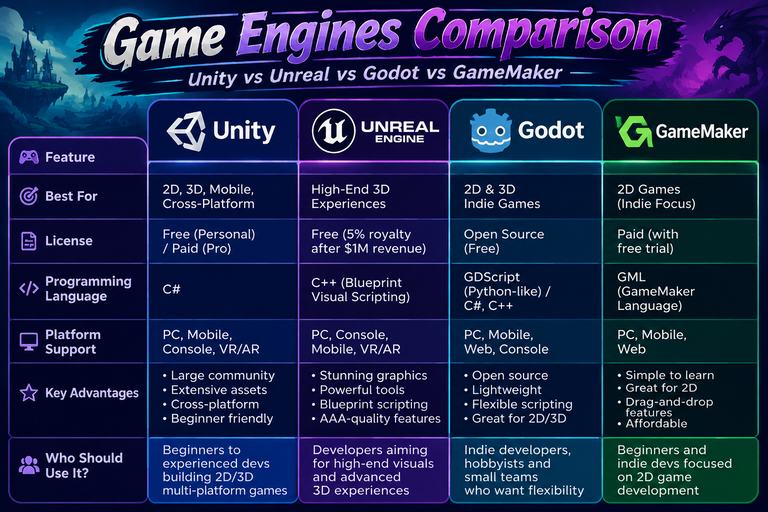
The most popular options include:
Unity
Unity is one of the world’s most widely used game engines for indie development.
It supports:
- 2D games
- 3D games
- Mobile
- PC
- Console
- VR
Its large community, extensive documentation, and massive asset ecosystem make it a popular choice for beginners and experienced developers alike.
Best for: 2D, mobile, cross-platform development.
Unreal Engine
Unreal Engine is known for producing high-end visuals and advanced rendering capabilities.
It offers:
- Blueprint visual scripting
- AAA-quality graphics
- Powerful cinematic tools
- Strong multiplayer support
Although often associated with large studios, many indie teams also use Unreal to create visually impressive games.
Best for: High-end 3D experiences.
Godot
Godot has become increasingly popular thanks to its open-source license and active community.
Developers appreciate:
- No licensing fees
- Lightweight editor
- Flexible scripting
- Strong 2D capabilities
It’s especially attractive for hobbyists, students, and small indie teams.
GameMaker
GameMaker has helped launch many successful 2D indie games.
It emphasizes simplicity while remaining powerful enough for commercial projects.
Its drag-and-drop features and scripting language make it approachable for beginners.
Creating the Art and Audio
Once gameplay feels solid, development shifts toward production.
This stage includes:
- Character art
- Environment design
- Animation
- Sound effects
- Background music
- User interface polish
- Accessibility improvements
A common misconception is that indie games must have pixel art.
In reality, indie developers use many visual styles, including:
- Hand-painted artwork
- Low-poly 3D
- Anime-inspired art
- Stylized realism
- Vector graphics
- Pixel art
The goal isn’t photorealism—it’s creating a consistent artistic identity.
Publishing on Steam
For many indie developers, launching on Steam is a major milestone.
Publishing a game involves much more than uploading a build.
Developers also prepare:
- Steam Store Page
- Capsule artwork
- Screenshots
- Gameplay trailer
- Game description
- System requirements
- Achievements
- Localization
- Community Hub
- Tags and keywords
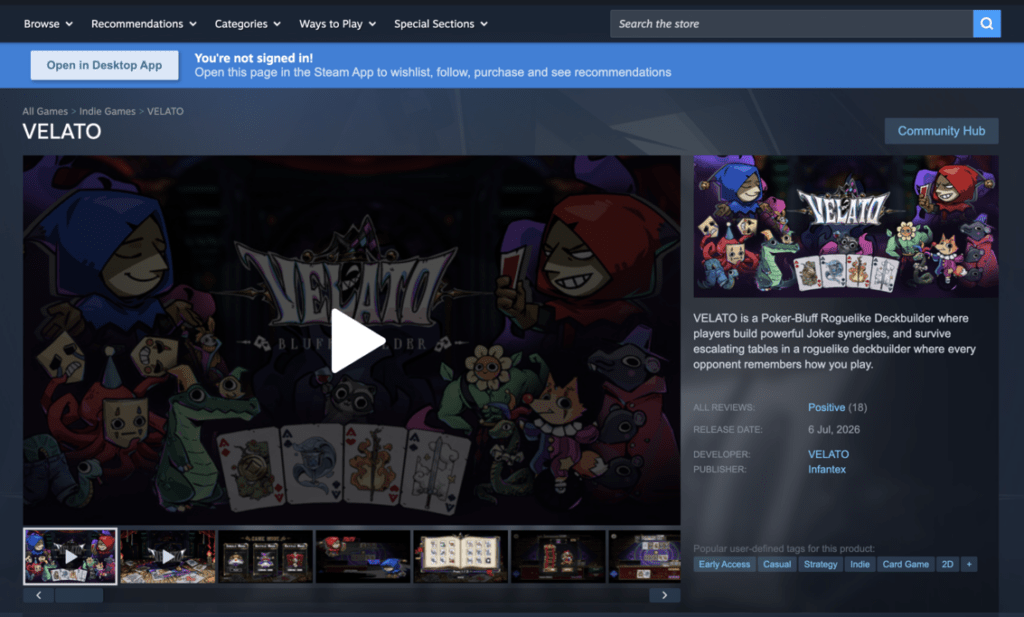
A well-designed Steam page can significantly influence wishlists and conversions before launch.
Take a look at Velato Steam Page as a Reference: https://store.steampowered.com/app/4542750/VELATO/
Marketing Starts Before Release
One of the biggest misconceptions about indie development is that marketing begins after the game is finished.
Successful indie studios often start marketing months—or even years—before launch.
Common marketing channels include:
- Steam wishlists
- Discord communities
- X (formerly Twitter)
- TikTok
- YouTube devlogs
- Press outreach
- Influencer collaborations
- Demo festivals such as Steam Next Fest
Building an audience early can make a significant difference on launch day.
The Biggest Challenges Indie Developers Face
Creating an indie game is rewarding, but it also comes with significant challenges.
Some of the most common include:
Limited Budget
Most indie teams operate with far fewer resources than AAA studios, making careful planning essential.
Wearing Multiple Hats
Developers often juggle programming, design, marketing, customer support, and business tasks simultaneously.
Discoverability
With thousands of games released each year, standing out on platforms like Steam is increasingly difficult.
Community Management
Listening to feedback, addressing bugs, and maintaining communication with players requires ongoing commitment long after launch.
Case Study: Velato — A Modern Indie Approach to Innovation
A good example of modern indie development is Velato, an upcoming independent title that combines roguelike progression with actual poker bluffing mechanics.
Instead of following the familiar deckbuilding formula, Velato explores a different design philosophy: encouraging players to read opponents, bluff strategically, and make calculated psychological decisions throughout each run.
This kind of experimentation reflects one of the greatest strengths of indie development. Small teams can pursue bold gameplay ideas that larger publishers may consider too niche or commercially risky.
Whether Velato becomes a breakout success or simply finds a dedicated audience, it illustrates how independent developers continue to expand the boundaries of strategy and roguelike design.
Why Indie Games Matter More Than Ever?
The gaming industry has changed dramatically over the past two decades.
Not long ago, creating and publishing a successful video game required a large budget, a major publisher, and access to retail distribution. Today, a small independent team—or even a single developer—can release a game on Steam and reach players around the world.
This shift has made indie games one of the most important driving forces in modern gaming.
Rather than competing with AAA studios on production budgets, indie developers compete on something far more valuable: original ideas.
Many of the mechanics, genres, and design philosophies that define today’s gaming landscape first gained popularity through indie games before influencing larger studios.
Innovation Begins with Indie Developers
One of the greatest strengths of indie development is the freedom to experiment.
Large publishers often invest tens or even hundreds of millions of dollars into a single game. With so much money at stake, they tend to prioritize familiar formulas that have already proven commercially successful.
Independent developers operate differently.
Smaller teams can take creative risks because they have:
- Lower development costs
- Smaller teams
- Faster production cycles
- Direct communication with players
- Greater creative control
This flexibility allows indie developers to explore ideas that might otherwise never be approved.
Over the years, indie studios have helped popularize genres and mechanics such as:
- Roguelike and roguelite progression
- Deckbuilding strategy games
- Cozy farming simulations
- Survival crafting
- Narrative exploration
- Psychological horror
- Rhythm-action hybrids
- Social deduction games
Many of these ideas eventually influenced games produced by much larger studios.
Steam Changed the Future of Indie Games
It’s impossible to discuss indie gaming without mentioning Steam.
When Valve introduced digital distribution, it fundamentally changed how games reached players.
Instead of negotiating with publishers and physical retailers, developers could now publish directly to one of the world’s largest PC gaming communities.
Steam also introduced features that particularly benefit indie developers:
- Wishlists
- User reviews
- Community hubs
- Achievements
- Early Access
- Steam Next Fest
- Workshop support
- Curator recommendations
These tools allow even small studios to build an audience long before launch.
For many indie developers today, accumulating Steam wishlists is one of the most important milestones before release.
Indie Games That Changed the Industry
Many of the most influential games of the last fifteen years were developed independently.
Let’s look at several titles that transformed gaming in different ways.
Stardew Valley — One Developer, One Global Phenomenon
When Eric Barone (known as ConcernedApe) began developing Stardew Valley, his goal was simple: create the farming game he had always wanted to play.
Working largely alone for several years, he handled programming, pixel art, animation, music, and game design.
The result became one of the best-selling indie games of all time.
Why it mattered:
- Revitalized the farming simulation genre.
- Demonstrated that a solo developer could build a commercially successful game.
- Created a passionate global community that continues to thrive years after launch.
Perhaps more importantly, Stardew Valley inspired countless aspiring indie developers to believe that small projects could achieve worldwide success.
Hollow Knight — World-Class Design from a Small Studio
Developed by the Australian studio Team Cherry, Hollow Knight became one of the defining metroidvania games of the modern era.
Players praised its:
- Hand-drawn visual style
- Challenging combat
- Intricate world design
- Atmospheric storytelling
- Exceptional value for money
Despite its modest team size, Hollow Knight earned critical acclaim comparable to many AAA titles.
It proved that exceptional game design often matters more than photorealistic graphics or blockbuster budgets.
Hades — Redefining the Roguelike Genre
Before Hades, many players viewed roguelikes as repetitive or unforgiving.
Supergiant Games changed that perception.
By combining:
- Fast-paced combat
- Rich storytelling
- Memorable characters
- Progressive narrative
- Meaningful upgrades
Hades demonstrated that roguelikes could deliver emotional storytelling without sacrificing replayability.
Its success influenced countless action games released afterward.
Balatro — Reinventing Poker Through Roguelike Design
Few indie games have grown as rapidly as Balatro.
At first glance, it appears to be a poker game.
In reality, it combines:
- Poker hands
- Deckbuilding
- Roguelike progression
- Strategic decision-making
- Risk management
Its success illustrates one of indie gaming’s greatest strengths: transforming a familiar concept into something entirely new.
Balatro also introduced many players to the growing poker roguelike genre.
Velato — Expanding the Poker Roguelike Genre
Among the newer generation of indie games, Velato represents another example of how independent developers continue to experiment with established genres.
While many poker-inspired roguelikes focus primarily on deckbuilding or score optimization, Velato explores a different direction by introducing actual poker bluffing mechanics into the core gameplay loop.
Instead of relying solely on numerical optimization, players must also consider:
- Reading opponents
- Bluffing convincingly
- Assessing risk
- Making psychological decisions
- Adapting to unpredictable situations
This emphasis on player psychology distinguishes Velato from many traditional roguelike card games.
Whether you’re a strategy enthusiast, a poker fan, or someone interested in innovative indie design, Velato highlights how independent studios can combine familiar concepts to create something fresh.
For aspiring developers, it’s also a reminder that innovation doesn’t always require reinventing an entire genre. Sometimes, introducing one compelling new mechanic can fundamentally change how players experience a game.
Indie Games Are More Than Entertainment
The impact of indie games extends beyond gameplay.
Many independent titles explore themes that larger publishers may avoid due to commercial concerns.
Examples include:
- Mental health
- Grief
- Identity
- Family relationships
- Moral dilemmas
- Environmental issues
- Social commentary
Because indie developers often answer only to themselves and their communities, they have greater freedom to tell personal, unconventional, or experimental stories.
This creative independence has broadened the diversity of voices represented in games and helped the medium mature as a form of artistic expression.
Indie Games and Community-Driven Development
One defining characteristic of indie development is the close relationship between creators and players.
Unlike many large studios, indie teams often communicate directly with their communities through:
- Steam Community
- Discord
- YouTube devlogs
- Social media
- Playtests and demos
Player feedback frequently influences development in meaningful ways.
Developers may adjust game balance, redesign features, improve accessibility, or even add entirely new mechanics based on community suggestions.
This collaborative process helps create games that feel shaped by both creators and players.
Indie Gaming Trends in 2026
The indie gaming landscape continues to evolve rapidly.
Some of the most notable trends include:
Hybrid Genres
Developers are blending mechanics from multiple genres to create fresh experiences.
Examples include:
- Poker + Roguelike
- City Builder + Survival
- Farming + RPG
- Deckbuilder + Auto Battler
- Horror + Puzzle Adventure
Replayability
Games designed around procedural generation, randomized encounters, and emergent gameplay continue to attract players looking for long-term value.
Community-Led Development
Early Access, public demos, and Steam Next Fest have become essential tools for gathering player feedback before launch.
Smaller Teams, Bigger Ambitions
Advances in modern game engines, AI-assisted workflows, and digital distribution allow independent studios to create increasingly polished experiences without AAA budgets.
Why Players Should Explore Indie Games
If you’ve only played blockbuster releases, you’re missing one of the most creative parts of the gaming industry.
Indie games offer:
- Original gameplay ideas
- Affordable prices
- Diverse art styles
- Passion-driven development
- Strong developer communities
- Experimental mechanics rarely found elsewhere
Whether you’re looking for a relaxing farming simulator, a deeply strategic card game, or an innovative roguelike, chances are an indie developer has already created something worth discovering.
Frequently Asked Questions (FAQ)
1. What is an indie game?
An indie game (short for independent game) is a video game developed without being financially or creatively controlled by a major publisher. Indie games are typically created by solo developers or small independent studios, giving creators greater freedom to experiment with gameplay, storytelling, and artistic direction.
2. What does “indie” mean in gaming?
“Indie” is short for independent. In the gaming industry, it refers to developers or studios that maintain creative independence rather than working under the direction of large publishers such as Electronic Arts, Ubisoft, or Activision.
3. Are all indie games made by one person?
No.
While some successful indie games are created by solo developers, many are developed by small teams ranging from five to fifty people. What makes a game indie is its independence—not the number of people involved.
4. What is an indie developer?
An indie developer, often called an indie dev, is a person or studio that creates games independently. They usually manage multiple aspects of development, including game design, programming, art, marketing, and community management.
5. What’s the difference between indie games and AAA games?
The biggest difference is creative independence.
AAA games are usually funded and managed by large publishers with substantial budgets and large development teams. Indie games, by contrast, are developed independently, often by much smaller teams with more freedom to take creative risks.
6. Are indie games only available on Steam?
No.
Although Steam is the largest platform for PC indie games, many indie titles are also available on:
- Nintendo Switch
- PlayStation
- Xbox
- Epic Games Store
- itch.io
- GOG
- Mobile app stores
7. Why are indie games often cheaper?
Indie studios generally have lower development and marketing costs than AAA publishers. As a result, many indie games can be sold at lower prices while still providing excellent value.
8. Do indie games have worse graphics?
Not at all.
Many indie developers intentionally choose stylized visuals—such as pixel art, hand-drawn illustrations, or low-poly 3D—to create a distinctive artistic identity. These choices are often creative decisions rather than technical limitations.
9. Can indie games be commercially successful?
Absolutely.
Games like Stardew Valley, Hollow Knight, Terraria, Hades, and Balatro have sold millions of copies worldwide, proving that innovative gameplay can compete with blockbuster productions.
10. How do indie developers fund their games?
Funding models vary and may include:
- Personal savings
- Crowdfunding
- Early Access
- Government grants
- Private investment
- Revenue from previous projects
- Independent publishers
Many studios combine several funding sources throughout development.
11. What game engine do indie developers use?
Popular game engines include:
- Unity
- Unreal Engine
- Godot
- GameMaker
The best choice depends on the project’s genre, platform, and the team’s experience.
12. Why are roguelike games so popular among indie developers?
Roguelikes encourage experimentation through procedural generation, replayability, and flexible game systems. These qualities make them well suited to the iterative development process common among indie studios.
13. Is Velato an indie game?
Yes.
Velato is an independent game that demonstrates how smaller studios can innovate within established genres. By combining roguelike progression with actual poker bluffing mechanics, it showcases the kind of creative experimentation often associated with indie development.
14. Can one person really make a game?
Yes.
Modern game engines, online learning resources, and digital distribution platforms have made solo development more accessible than ever. However, creating a commercial-quality game still requires significant time, dedication, and a broad range of skills.
15. Why do indie games matter?
Indie games drive innovation across the gaming industry. They introduce new mechanics, explore unconventional themes, and inspire both players and larger studios. Many ideas that become mainstream begin as experiments by independent developers.
Final Thoughts
Independent games have transformed the gaming industry by proving that great ideas can come from anywhere. Whether created by a solo developer working from home or a small studio collaborating across the world, indie games continue to challenge conventions and expand what interactive entertainment can achieve.
Unlike traditional AAA development, where commercial expectations often shape design decisions, indie developers have the freedom to experiment, iterate, and pursue unique creative visions. This independence has produced some of the most memorable games of the past decade, from peaceful farming simulators and atmospheric metroidvanias to innovative roguelikes and strategy card games.
Games such as Stardew Valley, Hollow Knight, Hades, and Balatro demonstrate that originality, thoughtful design, and community engagement can have just as much impact as blockbuster budgets. Emerging projects like Velato further illustrate how independent developers continue to evolve established genres by introducing fresh mechanics and new ways for players to engage with familiar ideas.
For players, indie games offer an opportunity to discover experiences that are often more personal, experimental, and diverse than mainstream releases. For aspiring developers, they serve as a reminder that success does not always require a large team or unlimited resources—it begins with a compelling idea, a commitment to craftsmanship, and the courage to create something different.
As digital distribution, accessible game engines, and global gaming communities continue to lower the barriers to entry, the future of indie development has never looked more promising. Whether you’re exploring your first indie title or building your own game, there’s never been a better time to be part of the indie gaming community.
Key Takeaways
- Indie stands for independent, referring to creative and financial independence rather than team size or graphics.
- Indie games are typically developed by solo creators or small studios with greater freedom to innovate.
- Platforms like Steam have made it easier than ever for indie developers to publish games globally.
- Indie titles have introduced many influential genres and mechanics that later inspired the wider industry.
- Successful indie games focus on originality, strong gameplay, and meaningful community engagement rather than massive budgets.
- Projects like Velato show how independent developers continue to explore fresh ideas, such as combining roguelike progression with authentic poker bluffing mechanics.
Related posts:
What Is a Roguelike Card Game? https://blog.velato.click/what-is-a-roguelike-card-game/
Top 10 Underrated Roguelike Games: https://blog.velato.click/top-10-underrated-roguelike-games-in-2026/
Games Like Balatro: Best Alternatives: https://blog.velato.click/games-like-balatro-12-amazing-alternatives-to-try-in-2026/
Steam Capsule Art Guide: https://blog.velato.click/steam-capsule-art-guide/
How to Set Up a Steam Store Page: https://blog.velato.click/how-to-set-up-a-store-page-on-steam/
Steam Tags Explained: https://blog.velato.click/steam-tags-explained-for-indie-dev/
Authoritative References
For credibility and E-E-A-T, cite reputable sources alongside official game websites:
Industry & Development
- Wikipedia – Indie Game: https://en.wikipedia.org/wiki/Indie_game
- GameMaker Blog – What Are Indie Games?: https://gamemaker.io/en/blog/what-are-indie-games
- Game Developers Conference (GDC): https://gdconf.com
- Steamworks Documentation: https://partner.steamgames.com
Gaming Media
- PC Gamer: https://www.pcgamer.com
- IGN: https://www.ign.com
- Rock Paper Shotgun: https://www.rockpapershotgun.com
Official Game Websites
- Stardew Valley: https://www.stardewvalley.net
- Team Cherry (Hollow Knight): https://www.teamcherry.com.au
- Supergiant Games (Hades): https://www.supergiantgames.com
- Balatro: https://www.playbalatro.com
- Velato: https://velato.click